Measurement guide

How to measure AI visibility without inventing a ranking

A repeatable measurement framework for a declared prompt panel, market, language, collection period and eligible answer interface. Every aggregate metric needs a visible numerator, denominator and answer-level evidence.

4 min read

Brand illustration for measuring AI visibility, with abstract interface shapes and no text.

Key takeaways

  • Write down the decision the measurement should inform before you collect.
  • Group real buyer questions by intent, market and language. Do not select only favourable prompts.
  • Repeat important prompts. One screenshot hides instability.
  • Mention rate, recommendation rate, citation rate, competitive presence, stability and citation diversity each need a definition.
  • Do not describe one generated answer as a permanent ranking.
Contents

Six moves before a metric

  1. Write down what the measurement should help you decide: content priorities, technical fixes, competitor gaps or authority work.
  2. Group real buyer questions by intent, funnel stage, market and language. Record inclusion rules instead of selecting only favourable prompts.
  3. Document the engine, interface, model when visible, location, language, account state, date and any other condition that can affect an answer.
  4. Collect more than one answer for important prompts. Repetition reveals instability that a single screenshot would hide.
  5. Keep the question, response, cited URLs and collection context together so every aggregate metric can be inspected later.
  6. Report what appeared in the sample before suggesting why it happened. Treat causal explanations as hypotheses to test.
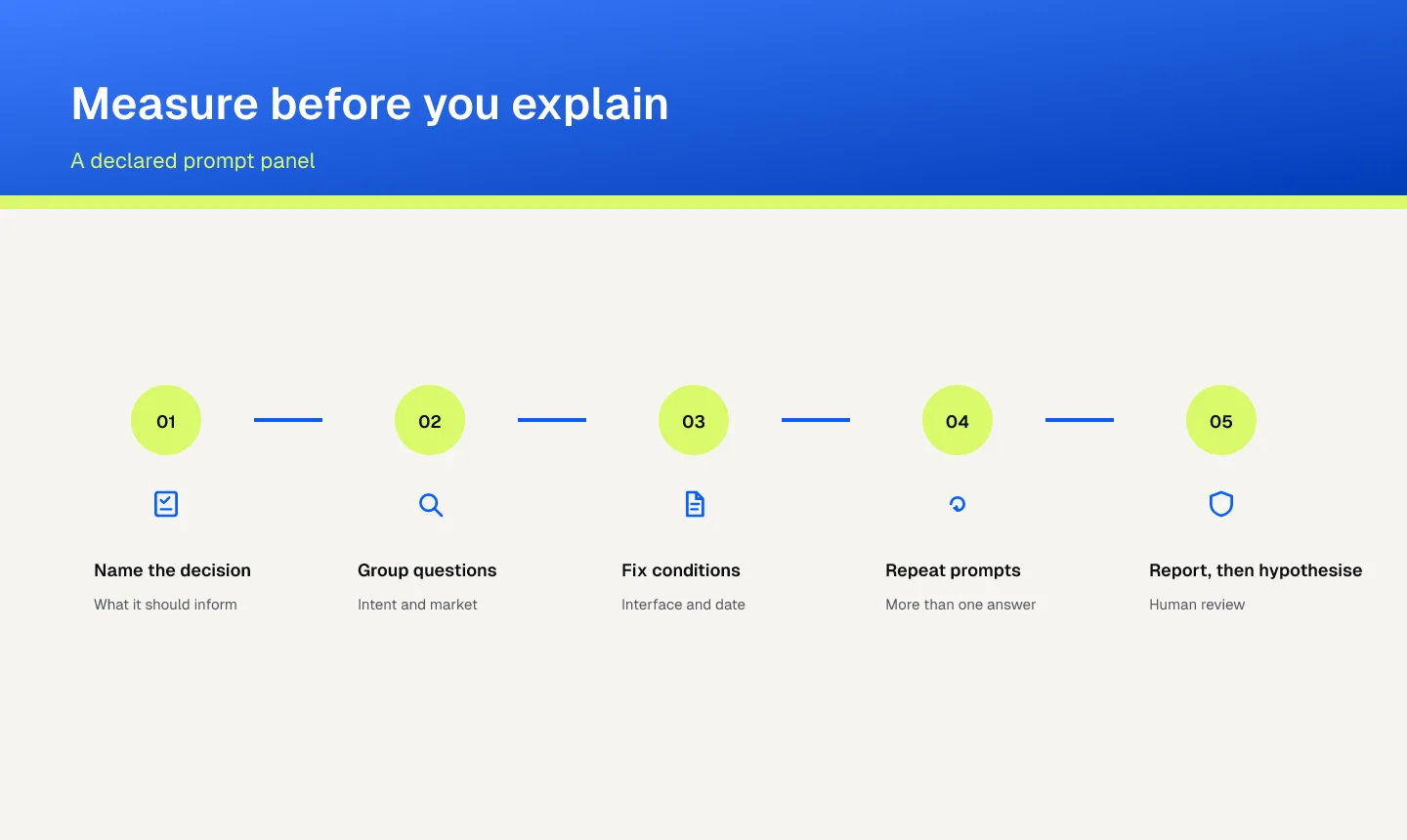
Five steps from naming the decision to grouping questions, fixing conditions, repeating prompts and reporting before a hypothesis.
The framework is not a universal AI ranking. It is a declared panel with answer-level evidence.

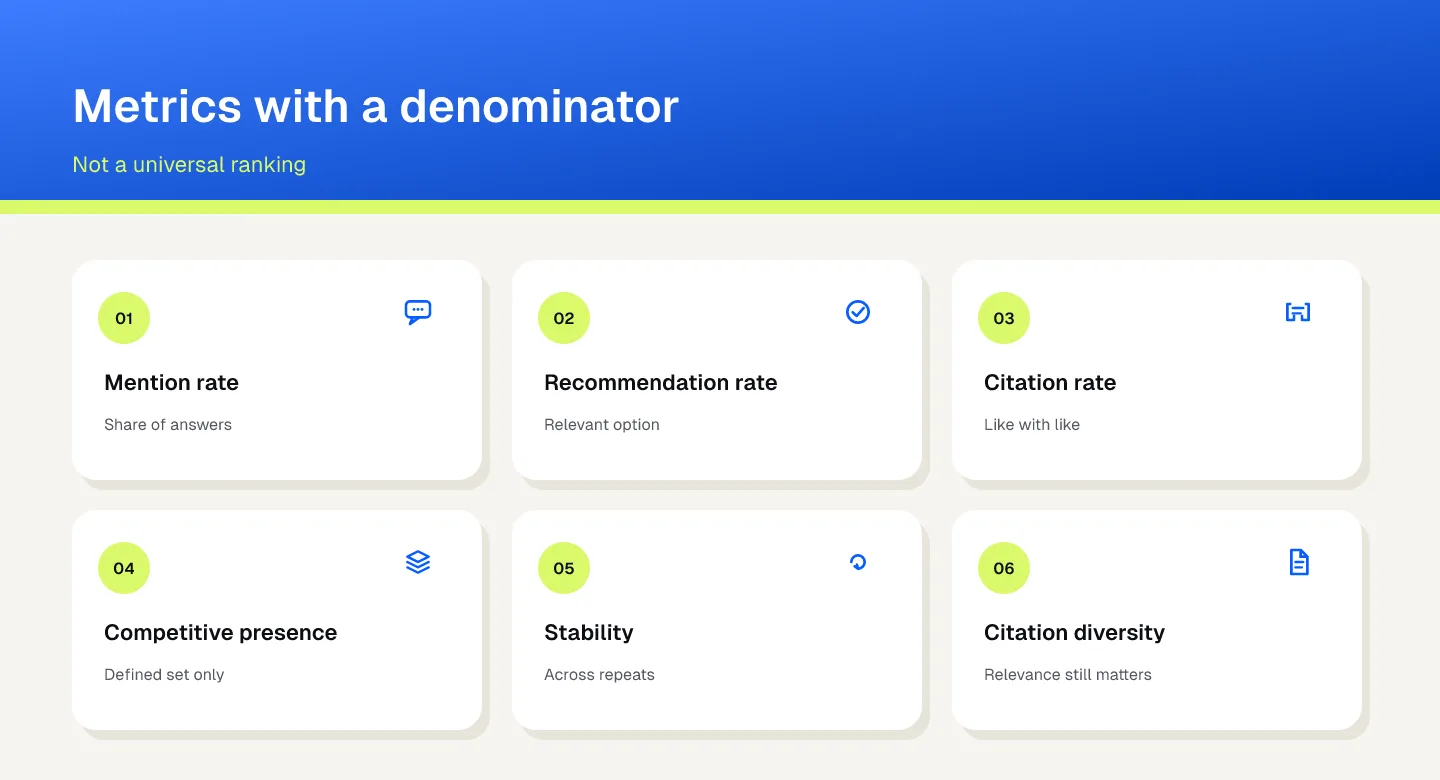
Metrics that keep a denominator

MetricWhat it isLimit
Mention rateShare of collected answers in which the brand appears.A mention can be neutral, positive or negative. Rate alone does not describe quality.
Recommendation rateShare of answers that present the brand as a relevant option.Define recommendation consistently and preserve the surrounding wording.
Citation rateShare of answers that cite a page or domain from the measured brand.Not every interface exposes sources, so compare like with like.
Competitive presenceBrand appearances relative to a defined competitor set.Results depend on the prompt panel and are not total market share.
StabilityConsistency of mentions, recommendations or citations across repeats.Low stability means small changes should not drive major decisions.
Citation diversityNumber and distribution of distinct source domains or pages.More sources are not automatically better. Relevance and authority still matter.
Working definitions for a declared sample
Six metric cards: mention rate, recommendation rate, citation rate, competitive presence, stability and citation diversity.
Each rate needs a visible numerator and denominator. None of them is a permanent ranking.

Reporting safeguards

  • Never describe one generated answer as a permanent ranking.
  • Do not combine engines, markets or languages without preserving segment-level results.
  • Do not infer revenue impact without conversion evidence and an appropriate comparison design.
  • Version the prompt panel and methodology so trend breaks remain explainable.
  • Keep missing answers, refusals and unavailable citations visible in the denominator rules.
  • Require human review before content, technical or outreach recommendations are executed.
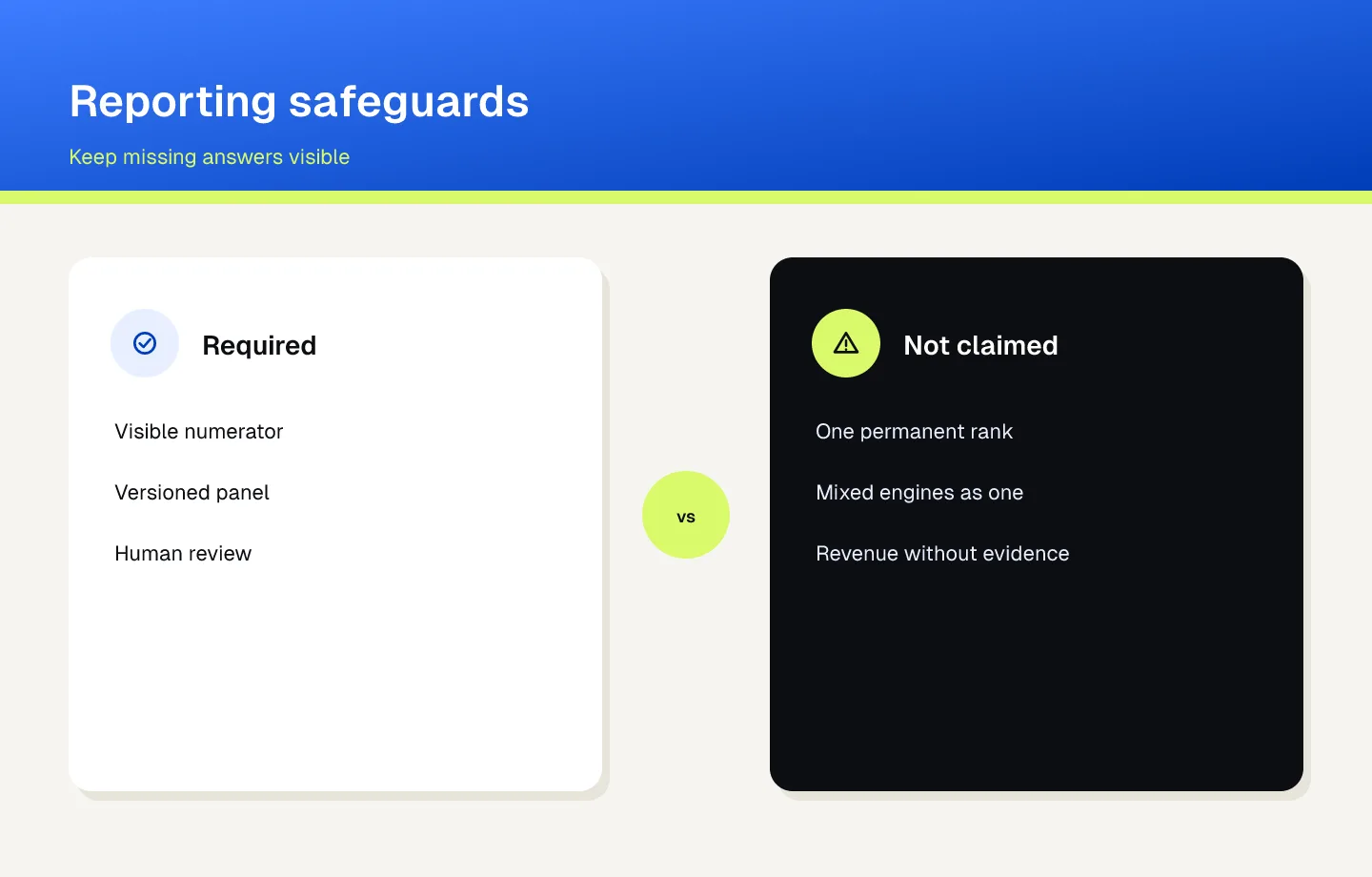
A split between required reporting, such as a visible numerator, and claims that are not made, such as one permanent rank.
Good measurement is as explicit about uncertainty as it is about the sample.

Frequently asked questions

Is this a ranking?

No. The framework records a declared prompt panel, market, language, collection period and eligible interface. It is not a universal AI ranking.

Why repeat a prompt?

One screenshot hides instability. Important prompts need more than one answer under documented conditions.

Can engines be combined into one score?

Not without preserving segment-level results. Unlike systems, markets and languages should stay visible.

Does a metric prove revenue impact?

No. Revenue claims need conversion evidence and an appropriate comparison design. A visibility change is not that evidence by itself.

Sources

These are ViziGEO working definitions. They are aligned with the published methodology, which states the formulas in more detail.

  1. ViziGEO measurement methodology
  2. Google: AI features and your website

Start a free AI visibility audit

Open ViziGEO and review a documented sample of questions, mentions, recommendations and citations. The audit records what was observed. It does not guarantee a mention, a citation or a recommendation.