AI search optimization starts with useful answers, not shortcuts
Build durable visibility across search and AI-generated answers by making your information useful, accessible, consistent and measurable.
ViziGEO Team3 min read
Key takeaways
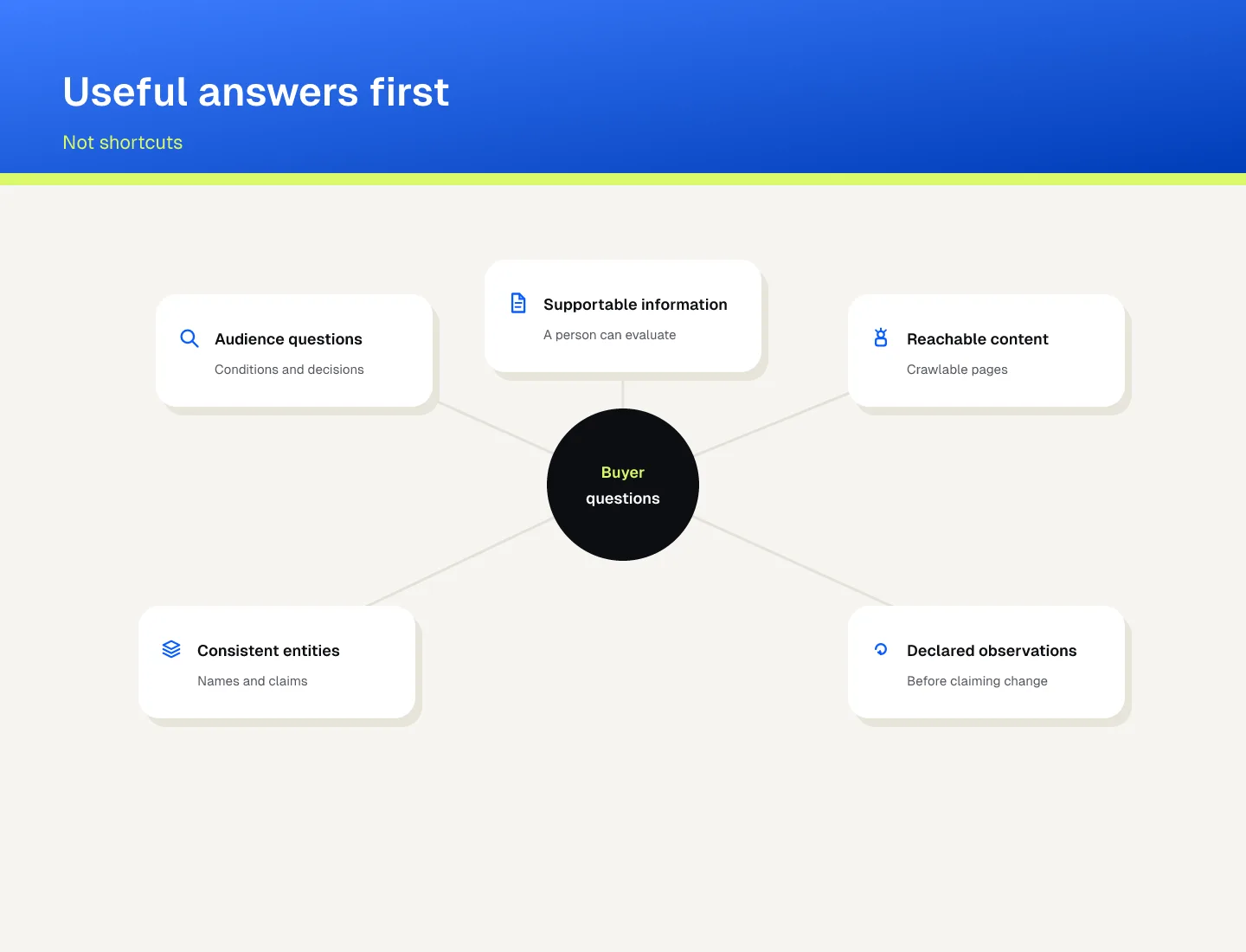
Organise content around buyer questions, conditions and decisions, not only isolated keyword variants.
Publish specific, supportable information a person can use to evaluate a product, method or category.
Keep important content reachable, crawlable and structurally understandable.
Use consistent names, claims, products and sources across the site and relevant references.
Observe mentions, recommendations and citations under a declared scope before deciding what changed.
Contents
What AI search optimization covers
AI search optimization is the practice of improving how useful, understandable and discoverable a brand information is for buyer questions that may be answered through search engines, answer engines and AI-generated interfaces.
GEO is commonly used for work related to generative answers. AI search optimization is a broader practical label that can include SEO, answer-engine content, technical access, entity consistency and citation evidence.
People use more interfaces to investigate a category. The reliable response is to improve the information system behind the brand, not to chase an unverified claim about how a model works.
Useful answers come from buyer questions, reachable pages, consistent entities and a declared observation, not from a shortcut.
A practical sequence
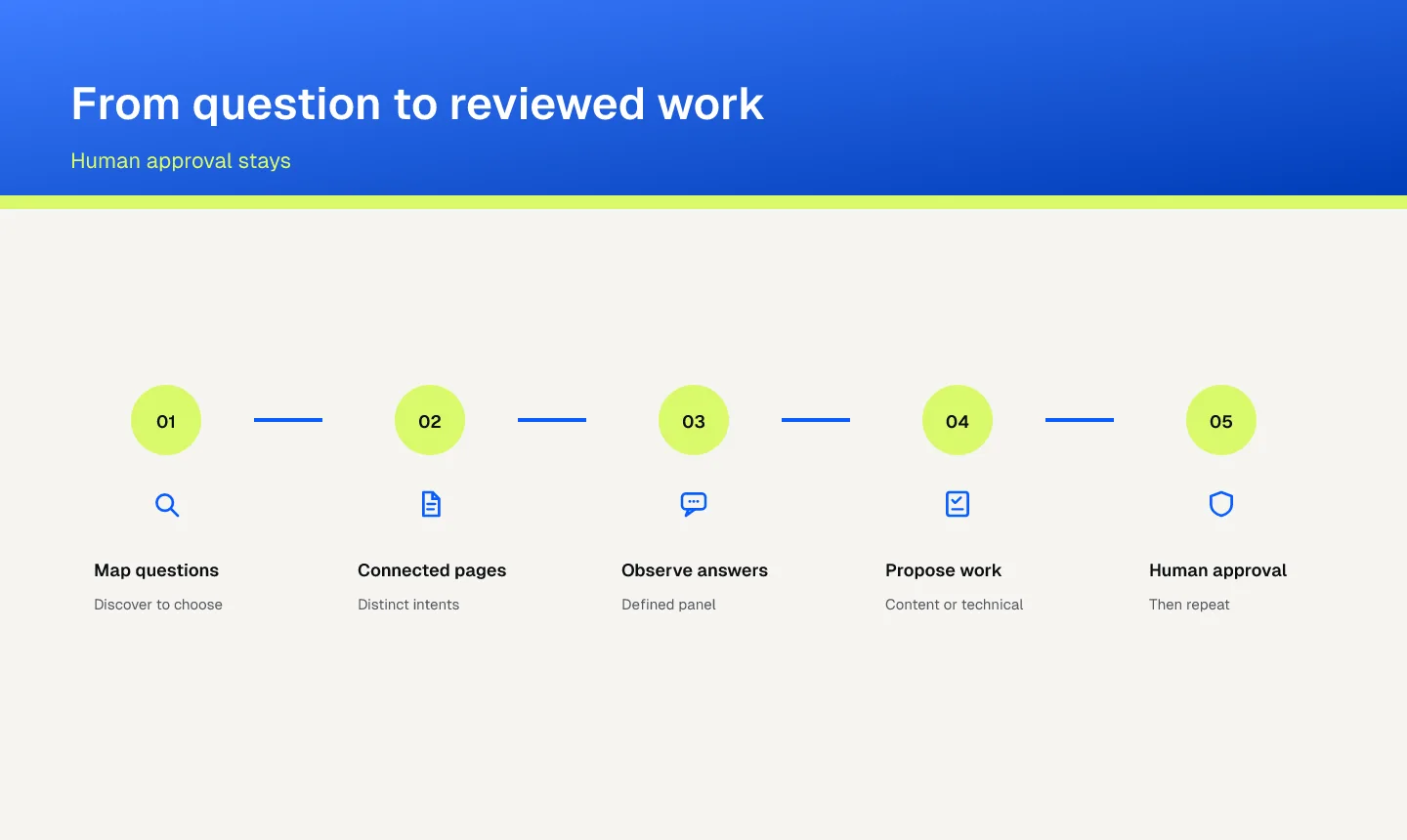
Map the questions a buyer asks when discovering a category, comparing options, validating a claim and choosing a next step.
Build connected category pages, explanatory guides, evidence pages and comparison frameworks that answer distinct intents.
Use a defined question panel and repeated observations to understand brand mentions, citations and competitor presence.
Turn evidence into prioritised content, technical or authority proposals, and retain human approval for external effects.
Observe a defined baseline, identify one evidence-backed gap, propose a controlled improvement, review the result and then repeat.
What not to treat as progress
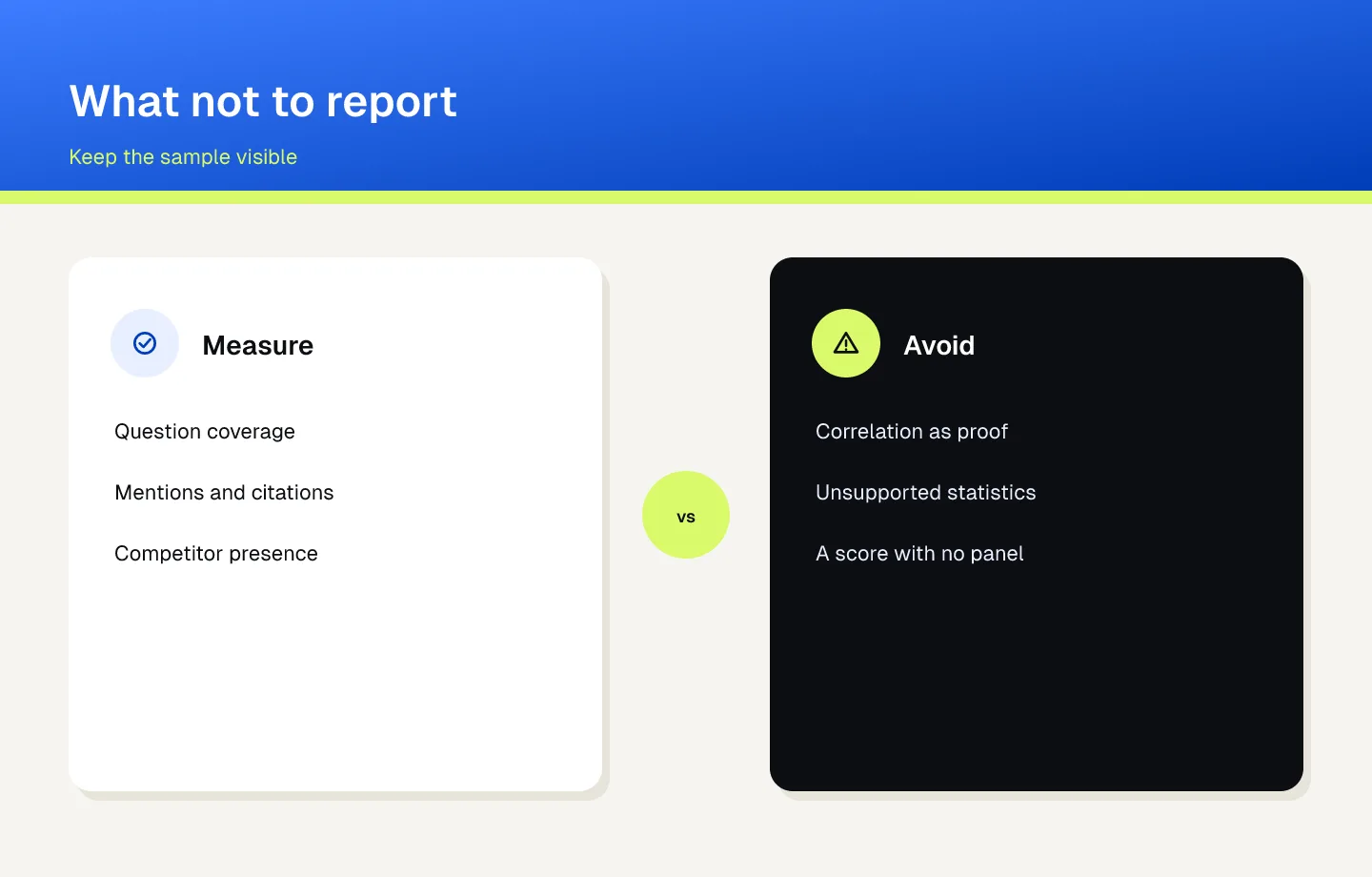
Calling correlation proof that one change caused an answer outcome.
Publishing unsupported statistics, reviews or comparisons.
Automating external publishing, outreach or code changes without accountability.
Reporting a visibility score without the question panel and denominator.
Should teams abandon traditional SEO? No. Accessible pages, useful content, sound information architecture and credible sources remain important. AI visibility work extends those foundations by adding prompt-level evidence, citations and answer context.
Measure question coverage, mentions, citations and competitor presence. Keep the sample and formulas visible.
Frequently asked questions
What is AI search optimization?
AI search optimization is the practice of improving how useful, understandable and discoverable a brand information is for buyer questions that may be answered through search engines, answer engines and AI-generated interfaces.
Is AI search optimization the same as GEO?
GEO, or generative engine optimization, is commonly used for work related to generative answers. AI search optimization is a broader practical label that can include SEO, answer-engine content, technical access, entity consistency and citation evidence.
Should teams abandon traditional SEO?
No. Accessible pages, useful content, sound information architecture and credible sources remain important. AI visibility work extends those foundations by adding prompt-level evidence, citations and answer context.
How do we measure progress?
Measure a defined sample over time: relevant question coverage, answer-level brand mentions, recommendation context, citations, competitor presence and stability. Keep the sample and formulas visible alongside any metric.
Sources
Claims about Google AI features in this guide follow Google Search Central. The working method is ViziGEO guidance, not a provider guarantee.
Open ViziGEO and review a documented sample of questions, mentions, recommendations and citations. The audit records what was observed. It does not guarantee a mention, a citation or a recommendation.