Generative engine optimization (GEO) is the practice of improving how accurately and usefully a brand, product or source can appear in generated answers, and of measuring those appearances within a documented sample.
ViziGEO Team6 min read
Key takeaways
GEO means improving how accurately and usefully a brand, product or source can appear in generated answers, then measuring those appearances inside a documented sample.
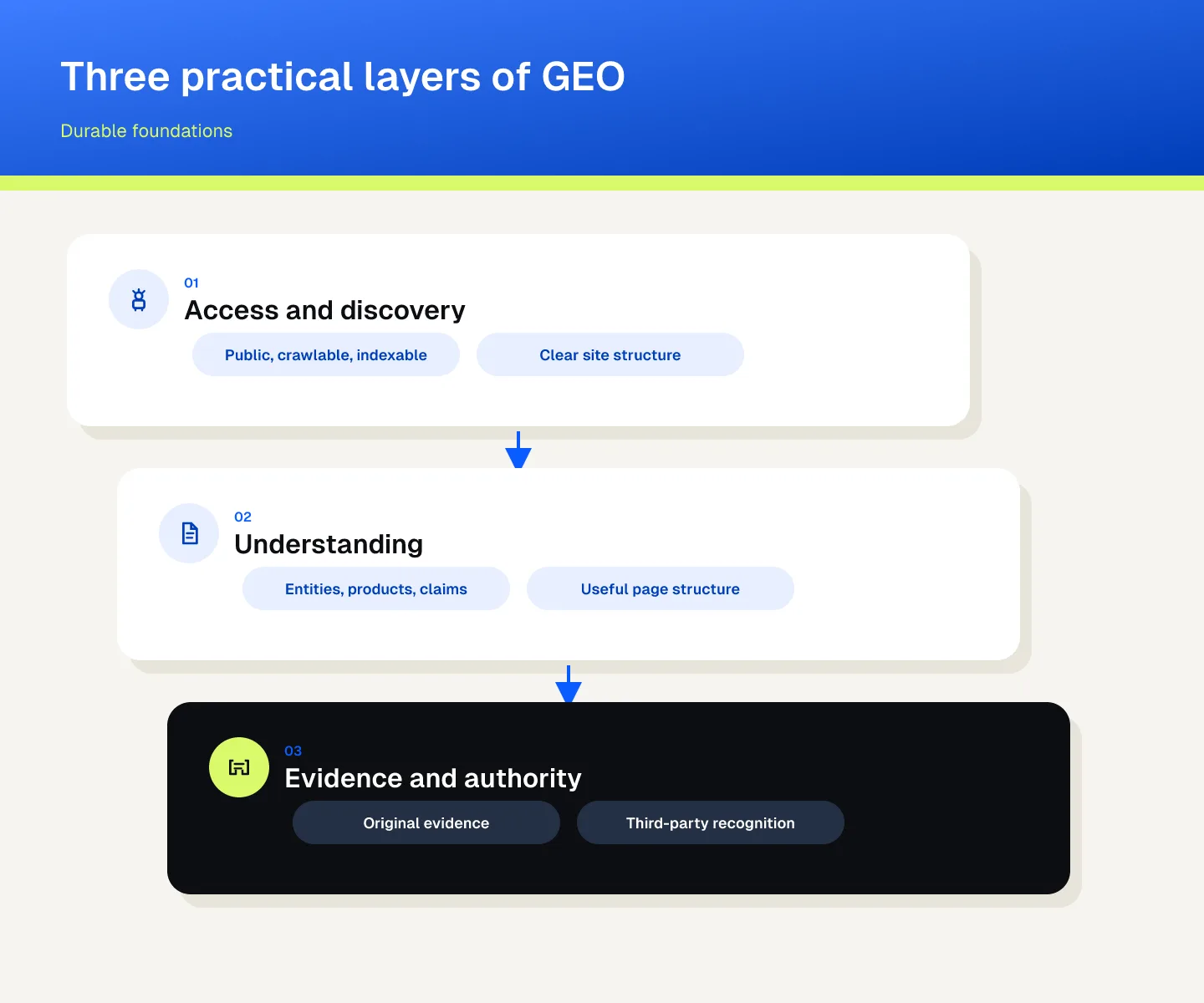
The practical work has three layers: access and discovery, understanding, and evidence and authority.
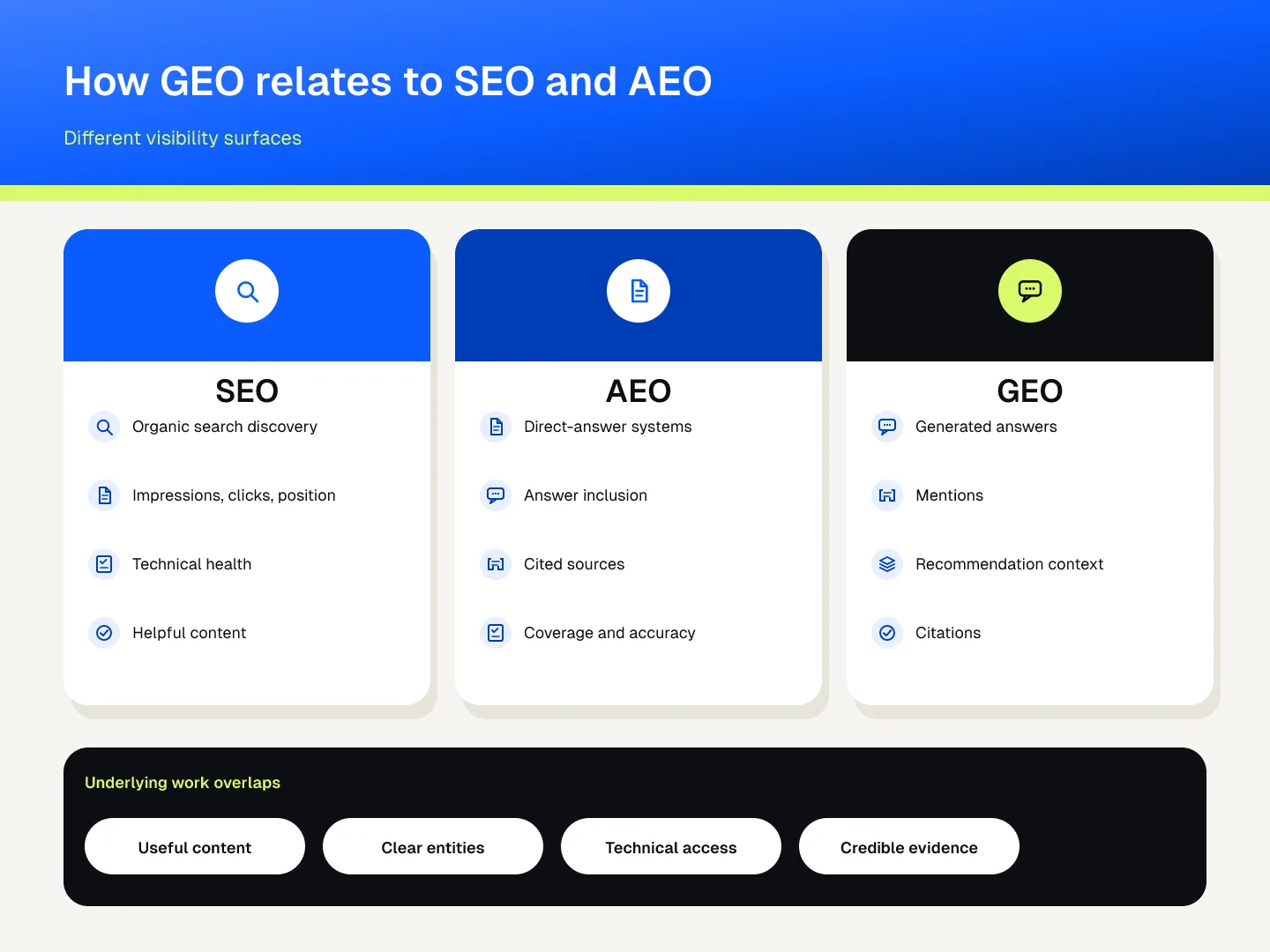
SEO, AEO and GEO describe different visibility surfaces. Useful content, clear entities, technical access and credible evidence overlap across them.
Measurement comes before optimization, and every external action remains subject to human approval.
GEO cannot control a model, guarantee a recommendation or create one universal AI ranking.
Contents
A working definition
Generative engine optimization is a working definition for a specific job: make important information easier to understand, then record how a brand, product or source actually appears in generated answers. The appearances that count are the ones collected inside a documented sample of questions and conditions.
A useful sample names the audience, the language, the buyer journey and the representative questions before anyone collects an answer. The same panel, repeated under fixed conditions, is what lets a team compare mentions, recommendation context and citations later.
Three practical layers of GEO
The work begins with durable foundations, not a secret prompt or isolated technical trick.
Access and discovery
Keep important information public, crawlable, indexable and connected through a clear site structure. This is the layer that makes a page possible to find and fetch. Search visibility, crawlability and helpful content remain important foundations, particularly for AI features within search.
Understanding
Explain entities, products, claims and relationships in precise language supported by useful page structure. A reader, and a system parsing the page, should be able to tell what the entity is, which claims the page makes and how those claims relate.
Evidence and authority
Publish original evidence and earn relevant third-party recognition that people and systems can verify. Original evidence is something the team can stand behind. Third-party recognition is something others have published and a reader can open.
The three practical layers of GEO are access and discovery, understanding, and evidence and authority. The work starts from those foundations.
How GEO relates to SEO and AEO
SEO, AEO and GEO describe different visibility surfaces, but much of the underlying work overlaps. Useful content, clear entities, technical access and credible evidence help people and machines understand a source.
Discipline
Focus
What a team can record
SEO
Organic search discovery and performance
Impressions, clicks, position, conversions and technical health
AEO
Clear, useful information for direct-answer systems
Answer inclusion, cited sources, coverage and accuracy
GEO
Representation in generated answers and recommendations
Mentions, recommendation context, citations, competitive presence and stability
Working comparison of SEO, AEO and GEO
The labels are not a ranking of importance, and GEO does not replace SEO. For a longer comparison, read GEO vs SEO vs AEO.
SEO, AEO and GEO describe different visibility surfaces. Useful content, clear entities, technical access and credible evidence sit underneath all three.
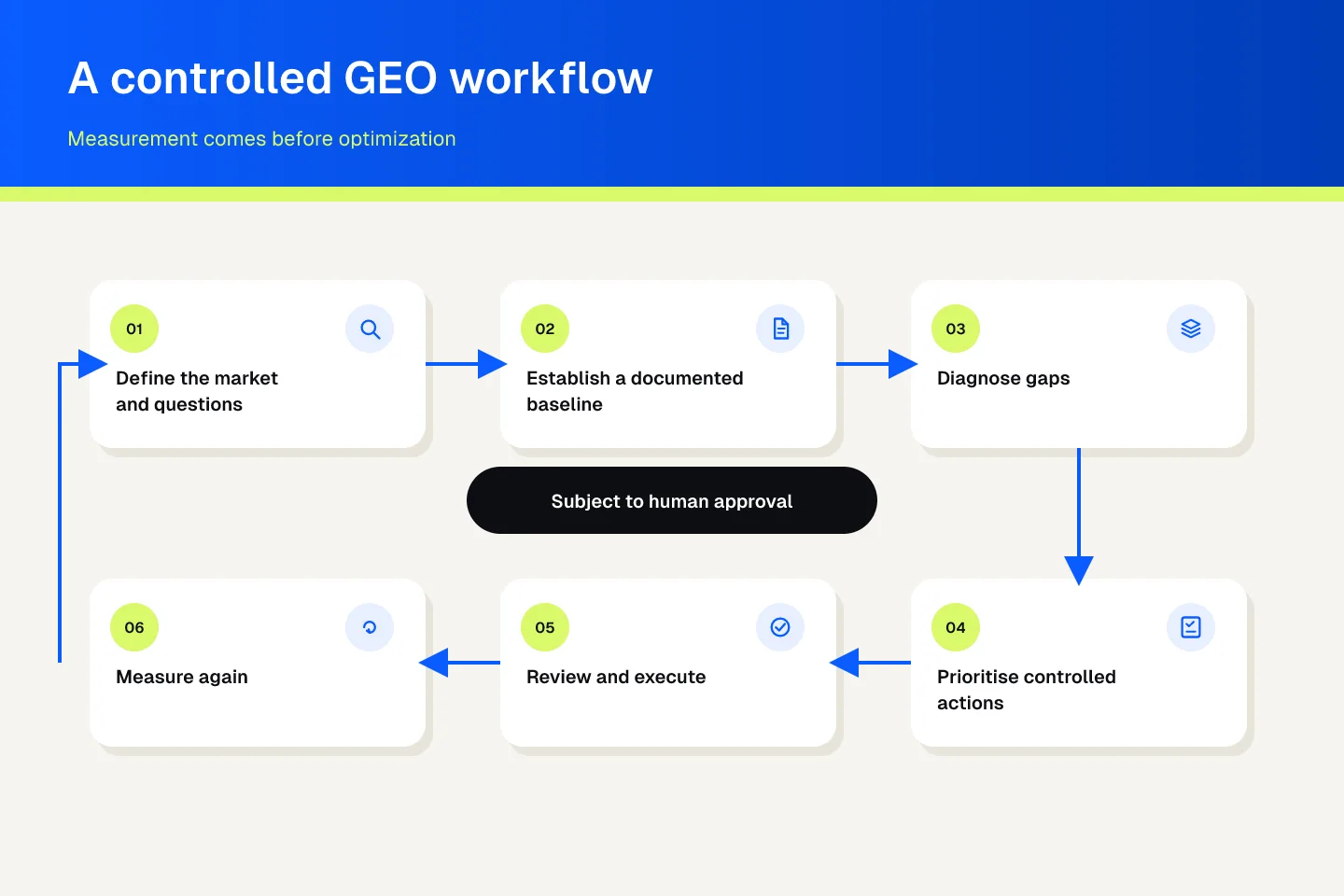
A controlled GEO workflow
Measurement comes before optimization, and every external action remains subject to human approval.
Define the market and questions. Choose the audience, language, buyer journey and representative questions before collecting answers.
Establish a documented baseline. Record systems, interfaces, dates, repetitions, answers and visible citations under fixed conditions.
Prioritise controlled actions. Propose content, technical and authority work with evidence, expected value and clear approval boundaries.
Review and execute. Require a person to approve publishing, code changes, outreach and other external actions.
Measure again. Repeat the same panel, preserve the evidence and distinguish observed change from unproven causality.
Teams that want this workflow in software can review GEO software and the guide to measuring AI visibility. A recorded sample is evidence about what was observed. It is not a promise that a later answer will mention or recommend the brand.
Measurement comes before optimization. A person still approves publishing, code changes, outreach and other external actions.
Common GEO misconceptions
These are the claims that most often outrun the evidence. Each correction is a limit on what a team should say, not a tactic.
Claim
Narrower reading
"GEO replaces SEO."
It does not. Search visibility, crawlability and helpful content remain important foundations, particularly for AI features within search.
"There is one permanent AI ranking."
Generated answers can vary by question, model, interface, market, account context and time. Results must be scoped to the observed sample.
"A special file or schema guarantees inclusion."
No markup, file or tactic guarantees a mention or citation. Structured data should accurately reflect visible content.
"Publishing more AI-written pages is GEO."
Volume without originality, evidence or user value can create noise rather than authority.
"A citation proves the optimization caused it."
A citation is an observation. Causal claims need an appropriate comparison design and repeated evidence.
Claims that need a narrower reading
Frequently asked questions
What is generative engine optimization?
Generative engine optimization, or GEO, is the practice of improving how accurately and usefully a brand, product or source can appear in generated answers, then measuring those appearances within a documented sample of questions and conditions.
How is GEO different from SEO?
SEO commonly focuses on discovery and performance in organic search results. GEO focuses on mentions, recommendation context and citations in generated answers. They overlap in technical access, useful content, entities and authority.
Can GEO guarantee that an AI system recommends a brand?
No. Generated outputs are probabilistic and controlled by the provider. GEO can improve relevant foundations and measure observed outcomes, but it cannot guarantee inclusion, wording or position.
How should GEO performance be measured?
Use a versioned panel of representative questions, fixed collection conditions, repeated observations and answer-level evidence. Report metrics such as mention rate, recommendation rate, citation rate, competitive presence and stability with their limitations.
Sources
The definition and measurement framework above are ViziGEO working definitions. Claims about Google Search are grounded in Google Search Central guidance.
Open ViziGEO and review a documented sample of questions, mentions, recommendations and citations. The audit records what was observed. It does not guarantee a mention, a citation or a recommendation.