AI Search Entity Knowledge Graph QA: keep brand facts consistent
AI systems assemble answers from repeated entity signals. A knowledge-graph QA pass checks whether your brand, product and authors are described consistently across pages and source contexts.
ViziGEO Team4 min read
Key takeaways
How to audit entity knowledge graph consistency for AI search visibility.
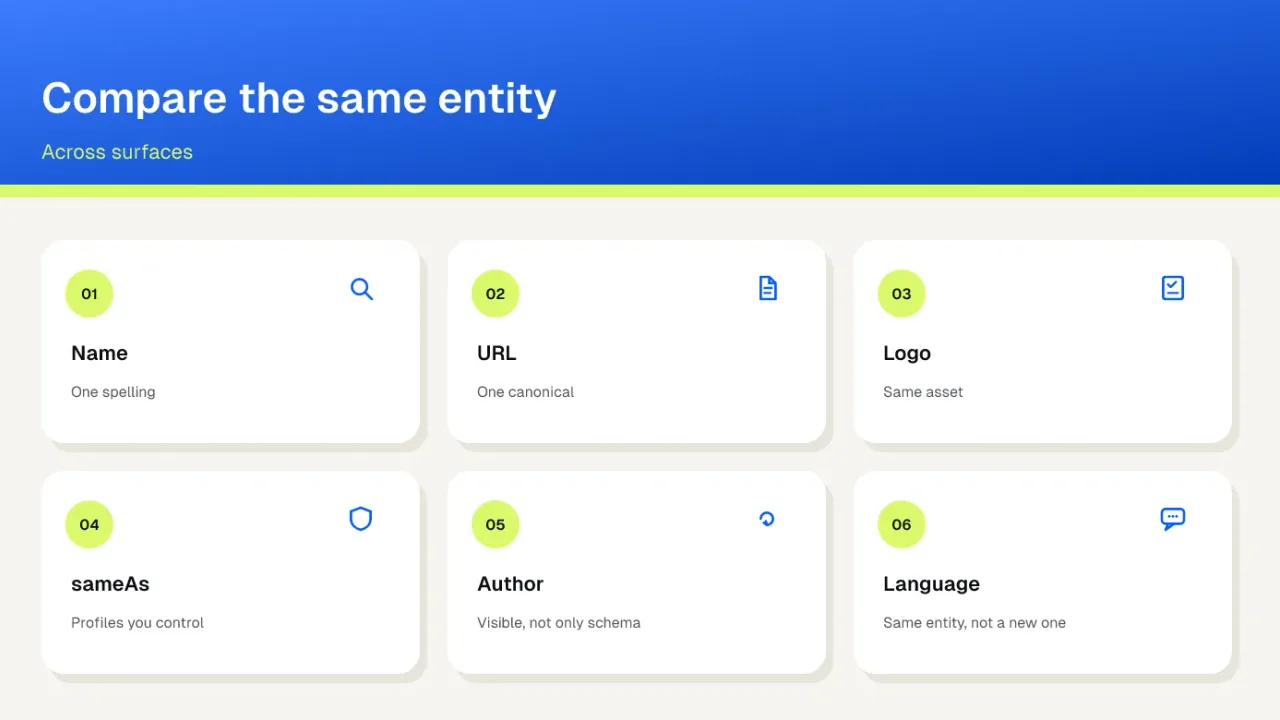
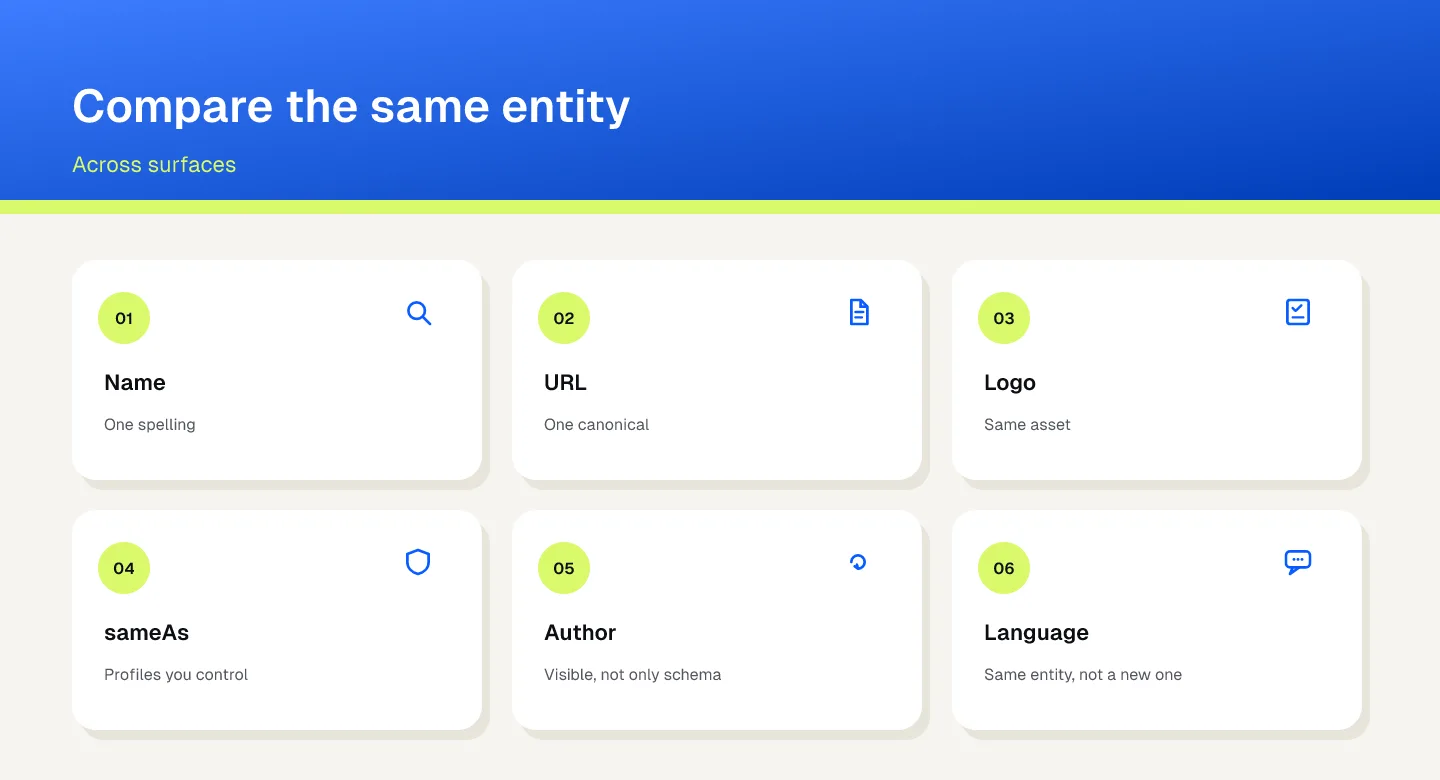
This QA compares how the organization, products and people are named across schema, navigation and localized pages. An author profile explains one person. A single-page name audit does not cover sameAs, logos and language equivalents.
Inventory the organization, product, person, category and problem entities that matter to the buyer journey.
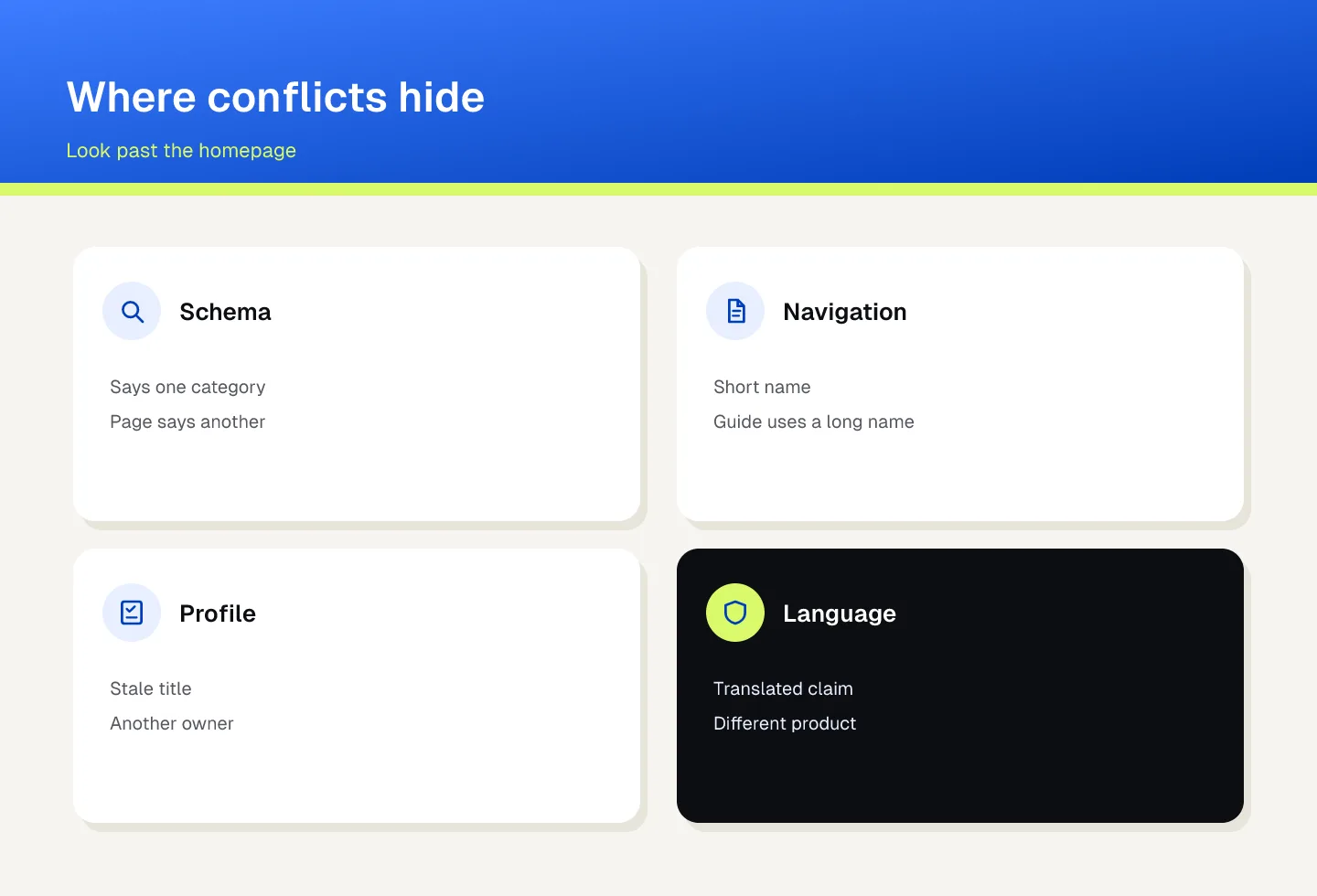
If a product page names one category while an author guide names another, an AI answer may merge the entities incorrectly; the QA log makes the conflict actionable.
Schema cannot force a model to select your entity.
Contents
What this workflow decides
How to audit entity knowledge graph consistency for AI search visibility.
AI systems assemble answers from repeated entity signals. A knowledge-graph QA pass checks whether your brand, product and authors are described consistently across pages and source contexts.
This QA compares how the organization, products and people are named across schema, navigation and localized pages. An author profile explains one person. A single-page name audit does not cover sameAs, logos and language equivalents.
How to do it
Inventory the organization, product, person, category and problem entities that matter to the buyer journey.
List the entities a buyer must not confuse: organization, product, person, category and problem.
Compare names, descriptions, URLs, logos, sameAs links, authorship and language across schema, navigation and editorial pages.
Compare names, URLs, logos, sameAs and authorship in schema and in visible navigation.
Trace important claims to a visible source page with a date, owner and evidence context.
Tie a material claim to a visible source page with a date and an owner.
Check localized pages for equivalent entities, canonical relationships, hreflang and translated claims.
On each language, check that the entity, canonical and hreflang still refer to the same thing.
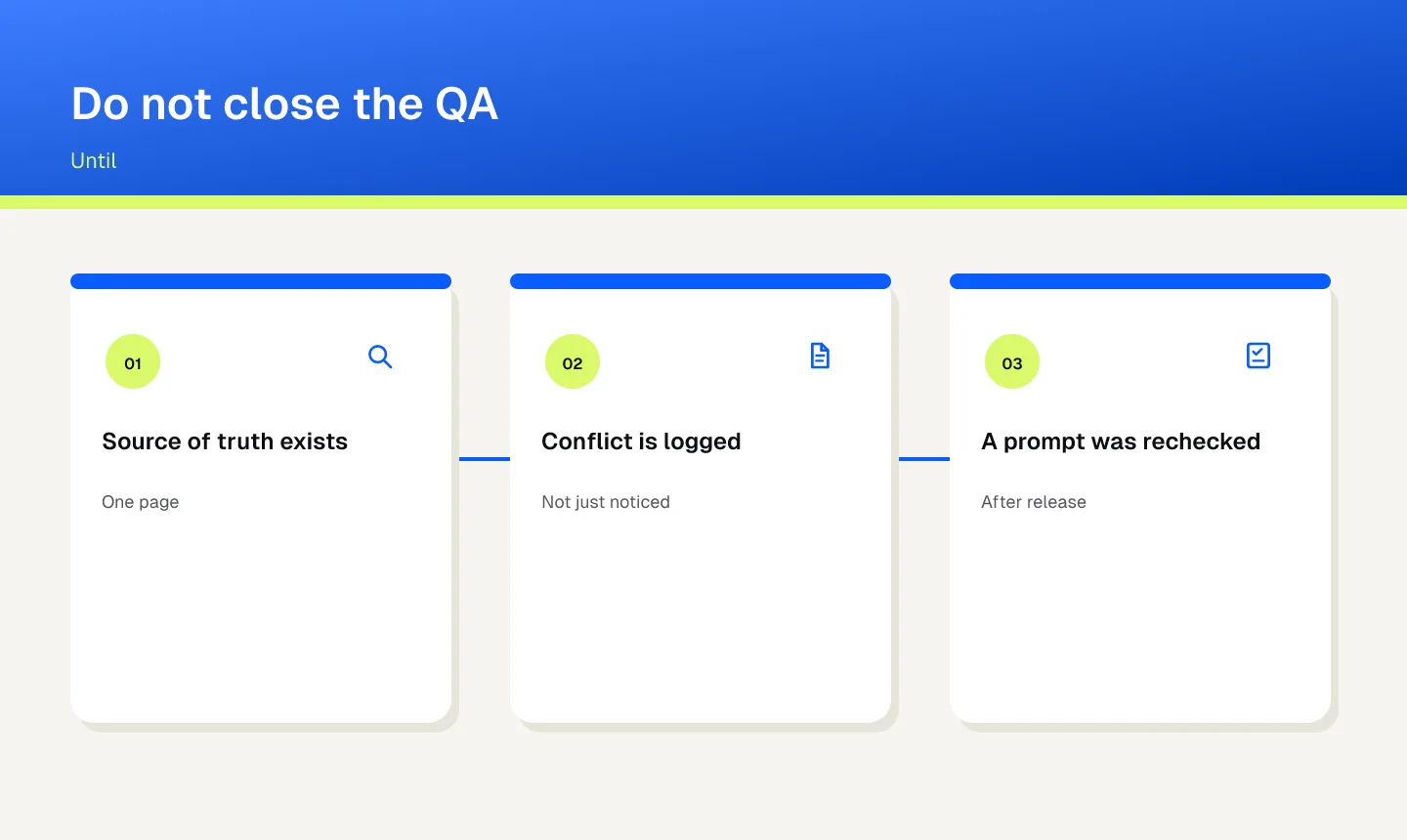
Log conflicts, choose a canonical source of truth and recheck representative prompts after release.
Log the conflict, pick the source of truth, and recheck a few prompts after release.
This QA compares how the organization, products and people are named across schema, navigation and localized pages. An author profile explains one person. A single-page name audit does not cover sameAs, logos and language equivalents.
What a finished record looks like
If a product page names one category while an author guide names another, an AI answer may merge the entities incorrectly; the QA log makes the conflict actionable.
What to keep in the record
Entity inventory for the buyer journey
Conflicts in names, sameAs and logos
Source of truth and its owner
Prompts rechecked after release
List the entities a buyer must not confuse: organization, product, person, category and problem.
What changes the conclusion
Schema cannot force a model to select your entity.
Third-party profiles may remain stale.
Entity consistency does not replace helpful content or distribution.
If a product page names one category while an author guide names another, an AI answer may merge the entities incorrectly; the QA log makes the conflict actionable.
Frequently asked questions
Does matching schema force a model to pick your entity?
No. Schema is a consistent description, not a selection guarantee.
Will third-party profiles update with your page?
Not by themselves. They can stay stale and need their own owner.
Is consistent naming the same as authority?
No. Consistency stops contradictions. It does not create proof.
Sources
These are the official sources for the part of the workflow they govern. A documented workflow is not a ranking or a citation outcome.
Open ViziGEO and review a documented sample of questions, mentions, recommendations and citations. The audit records what was observed. It does not guarantee a mention, a citation or a recommendation.