AI Search Keyword Cannibalization Audit: assign one clear page owner
Multiple pages can target the same question while none becomes the clearest answer. A cannibalization audit makes intent, evidence and internal links converge on one page owner.
ViziGEO Team3 min read
Key takeaways
How to audit and fix keyword cannibalization for AI search and organic SEO.
This audit finds several pages answering one buyer question and assigns a single owner. Pruning decides whether a URL should remain. A link audit inventories the graph. Here the question is which page is allowed to answer.
Export queries and landing pages from Search Console, then group variants by buyer question, entity and funnel stage.
A glossary definition, a comparison page and a tutorial can coexist when each owns a different intent; three near-identical tutorials create ambiguity.
Similar words do not always mean cannibalization.
Contents
What this workflow decides
How to audit and fix keyword cannibalization for AI search and organic SEO.
Multiple pages can target the same question while none becomes the clearest answer. A cannibalization audit makes intent, evidence and internal links converge on one page owner.
This audit finds several pages answering one buyer question and assigns a single owner. Pruning decides whether a URL should remain. A link audit inventories the graph. Here the question is which page is allowed to answer.
How to do it
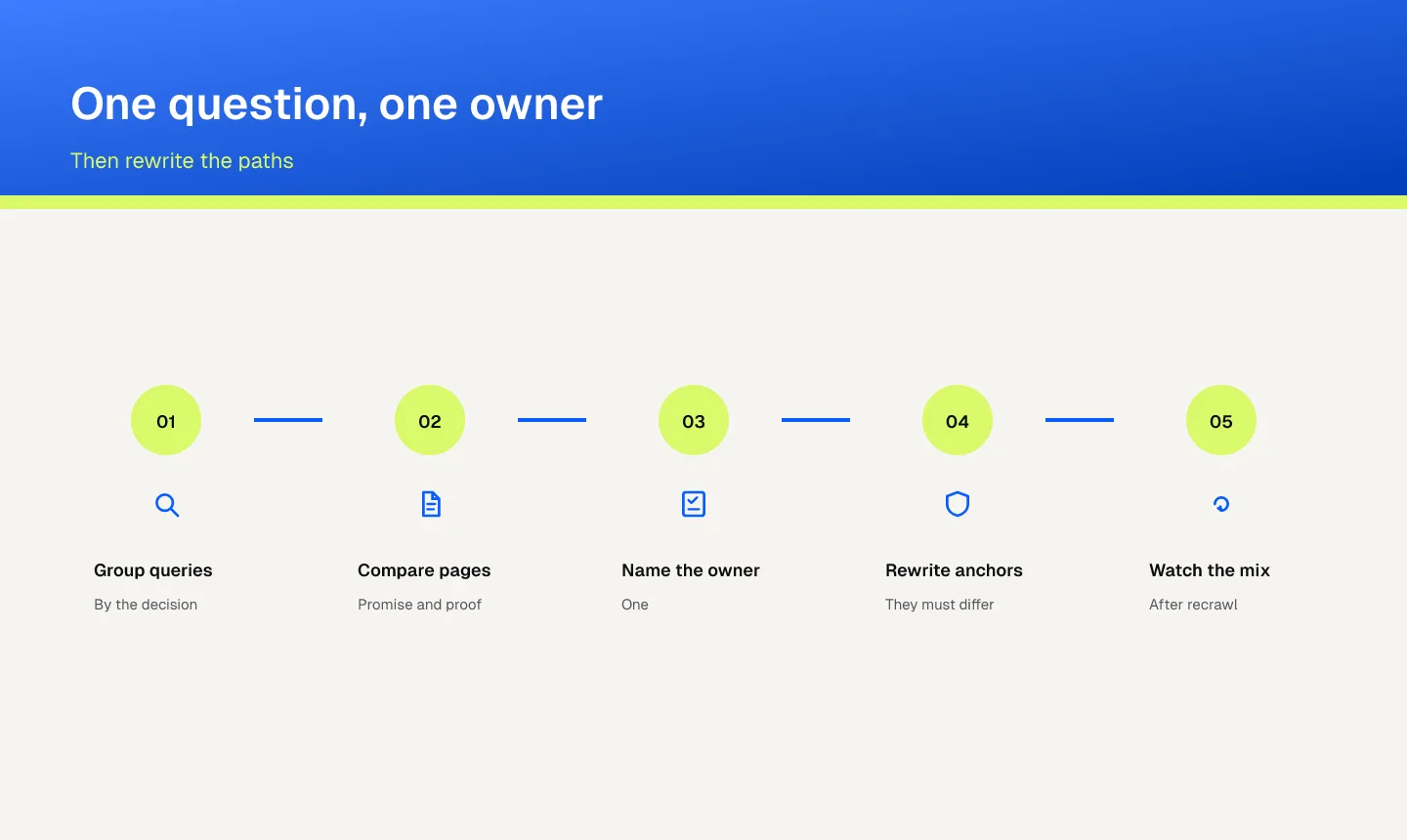
Export queries and landing pages from Search Console, then group variants by buyer question, entity and funnel stage.
Group queries by the buyer question, not by a shared word.
Compare each page title, H1, answer promise, evidence, links, conversions and indexed state for overlapping groups.
Compare title, promise, evidence and index state inside the group.
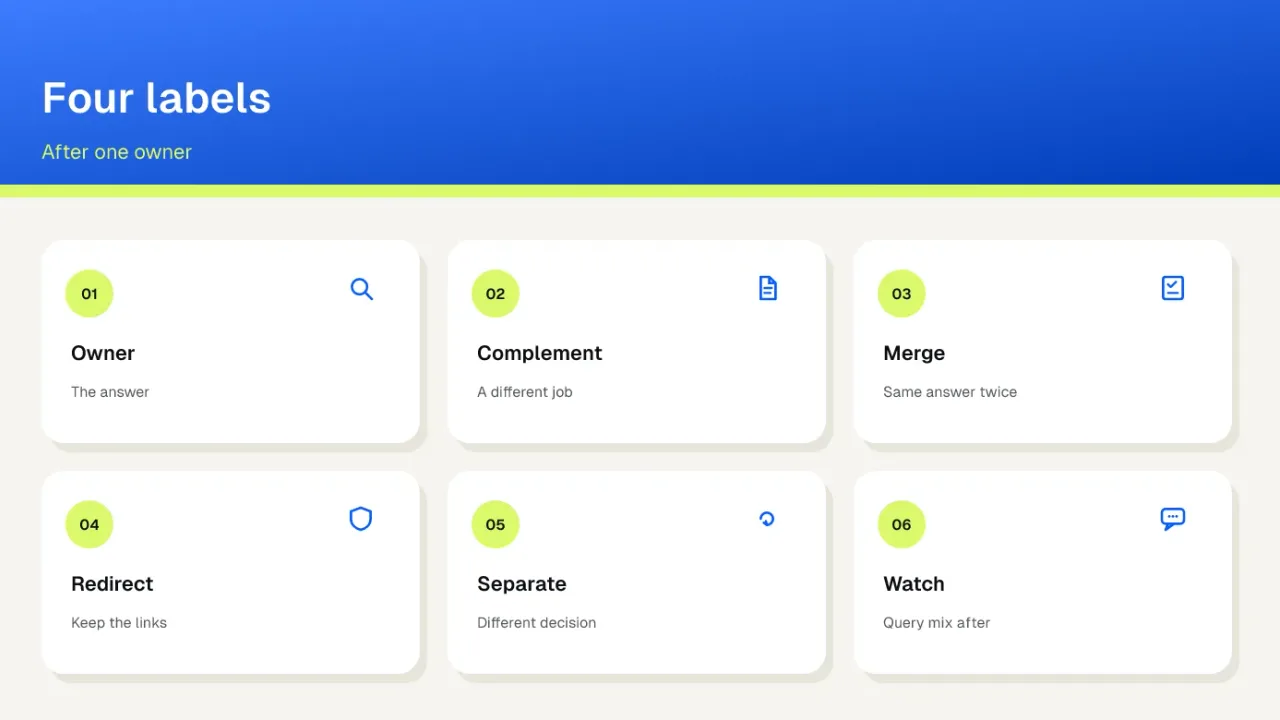
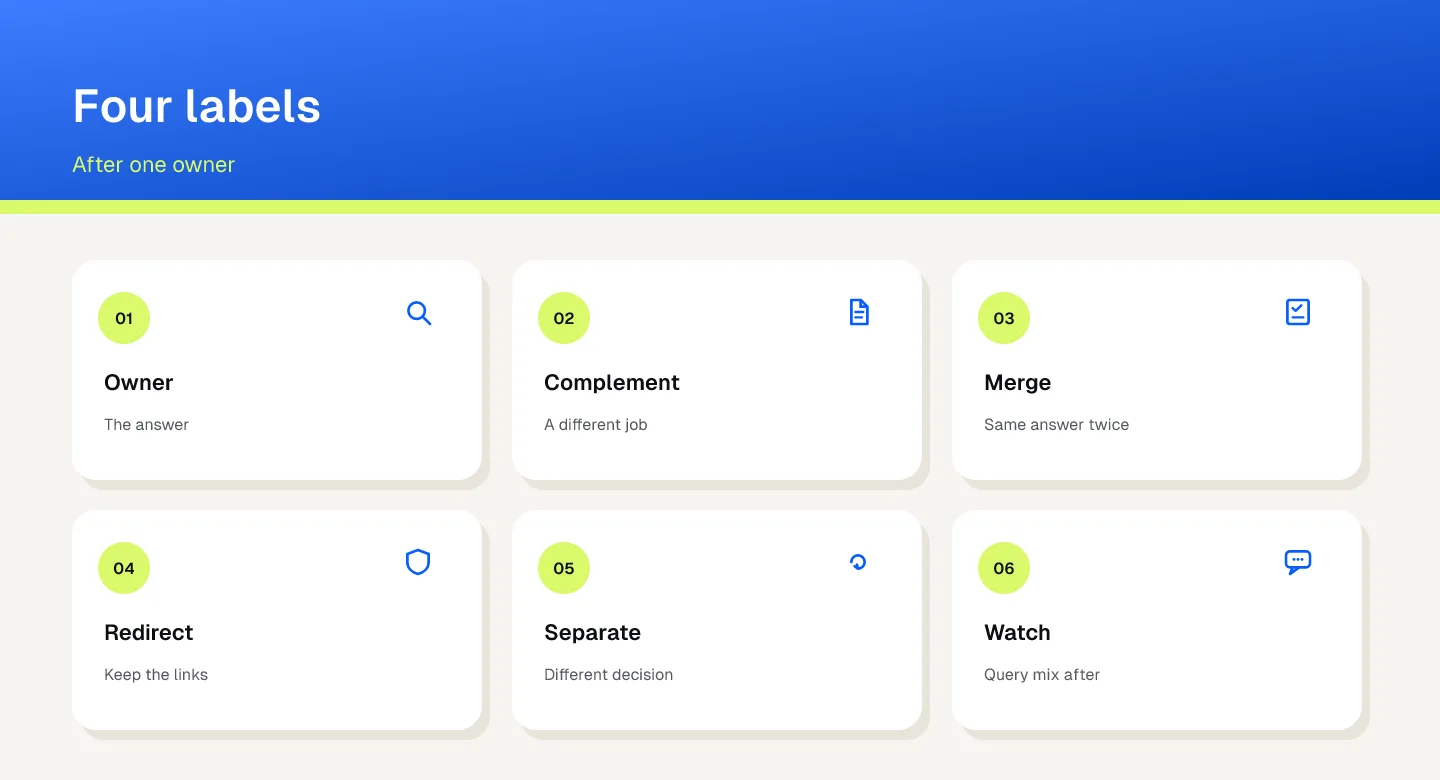
Choose one primary owner and classify supporting pages as complementary, merge candidates, redirects or separate intents.
Name one owner. Mark the others as complementary, merge, redirect or a genuinely different intent.
Rewrite titles, headings, anchors and contextual links so the cluster explains the relationship without duplicating the same answer.
Rewrite anchors so they explain the relationship instead of repeating the same answer.
Annotate the change and monitor impressions, clicks, query distribution, engagement and conversions after recrawl.
Watch query distribution after recrawl. Similar words alone are not cannibalization.
This audit finds several pages answering one buyer question and assigns a single owner. Pruning decides whether a URL should remain. A link audit inventories the graph. Here the question is which page is allowed to answer.
What a finished record looks like
A glossary definition, a comparison page and a tutorial can coexist when each owns a different intent; three near-identical tutorials create ambiguity.
What to keep in the record
Query group and the buyer question
Pages compared and the chosen owner
Complement, merge, redirect or separate intent
Query distribution after recrawl
Group queries by the buyer question, not by a shared word.
What changes the conclusion
Similar words do not always mean cannibalization.
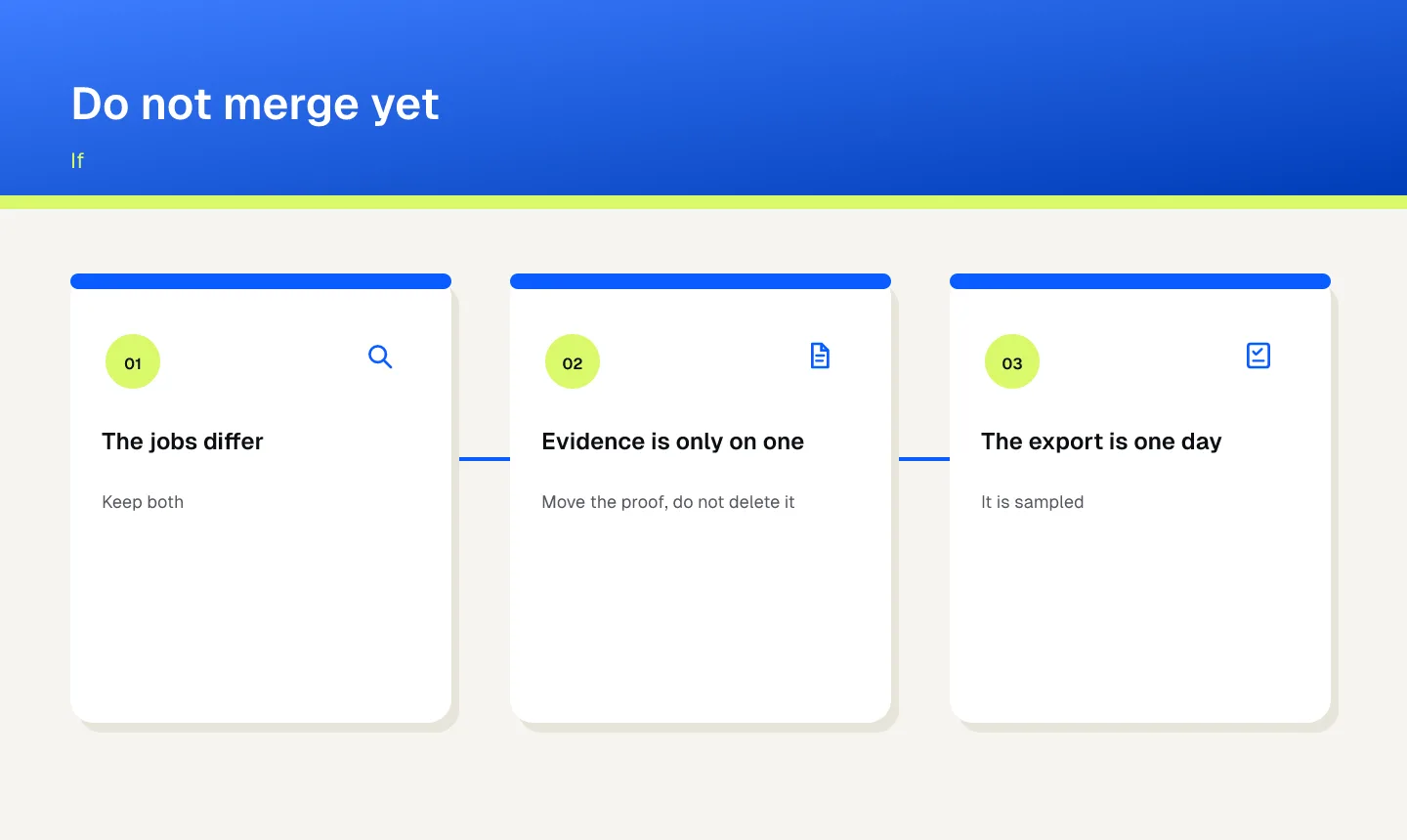
Consolidation can remove useful intent coverage if done blindly.
Search Console query data is delayed and sampled.
A glossary definition, a comparison page and a tutorial can coexist when each owns a different intent; three near-identical tutorials create ambiguity.
Frequently asked questions
Do similar words always mean cannibalization?
No. A definition, a comparison and a tutorial can coexist when each owns a different job.
Can consolidation delete useful coverage?
Yes, if you merge pages that answered different decisions.
Is the query export complete?
No. It is delayed and sampled. Write that on the audit.
Sources
These are the official sources for the part of the workflow they govern. A documented workflow is not a ranking or a citation outcome.
Open ViziGEO and review a documented sample of questions, mentions, recommendations and citations. The audit records what was observed. It does not guarantee a mention, a citation or a recommendation.