Does allowing an AI crawler guarantee a citation?
No. Access only makes retrieval possible. It does not guarantee crawling, indexing, citation, recommendation or any particular wording.
Technical guide
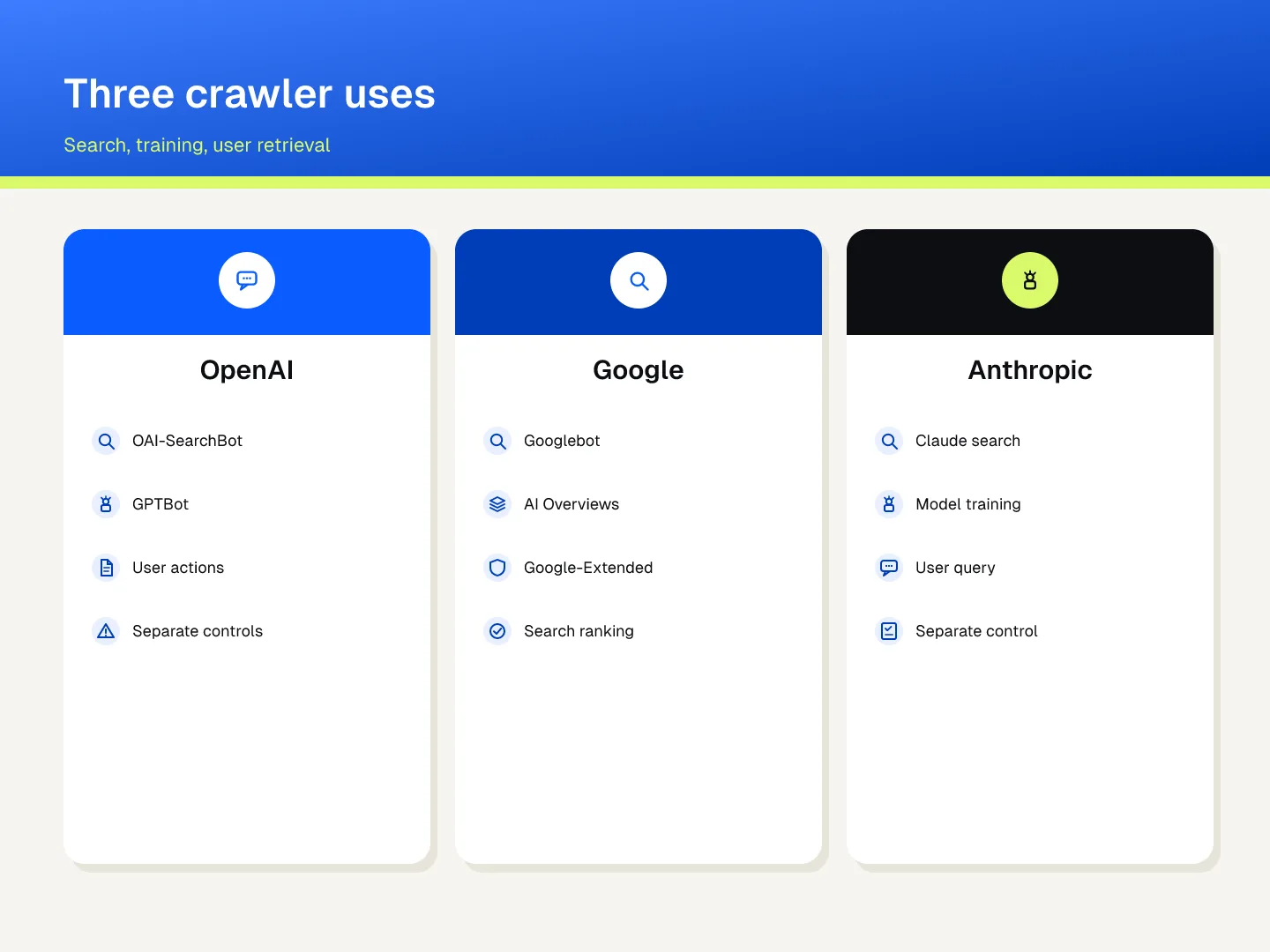
AI providers may use separate crawlers for search discovery, model training and content retrieval requested by a user. A safe policy starts by deciding which use you intend to allow, not by copying a universal bot list.
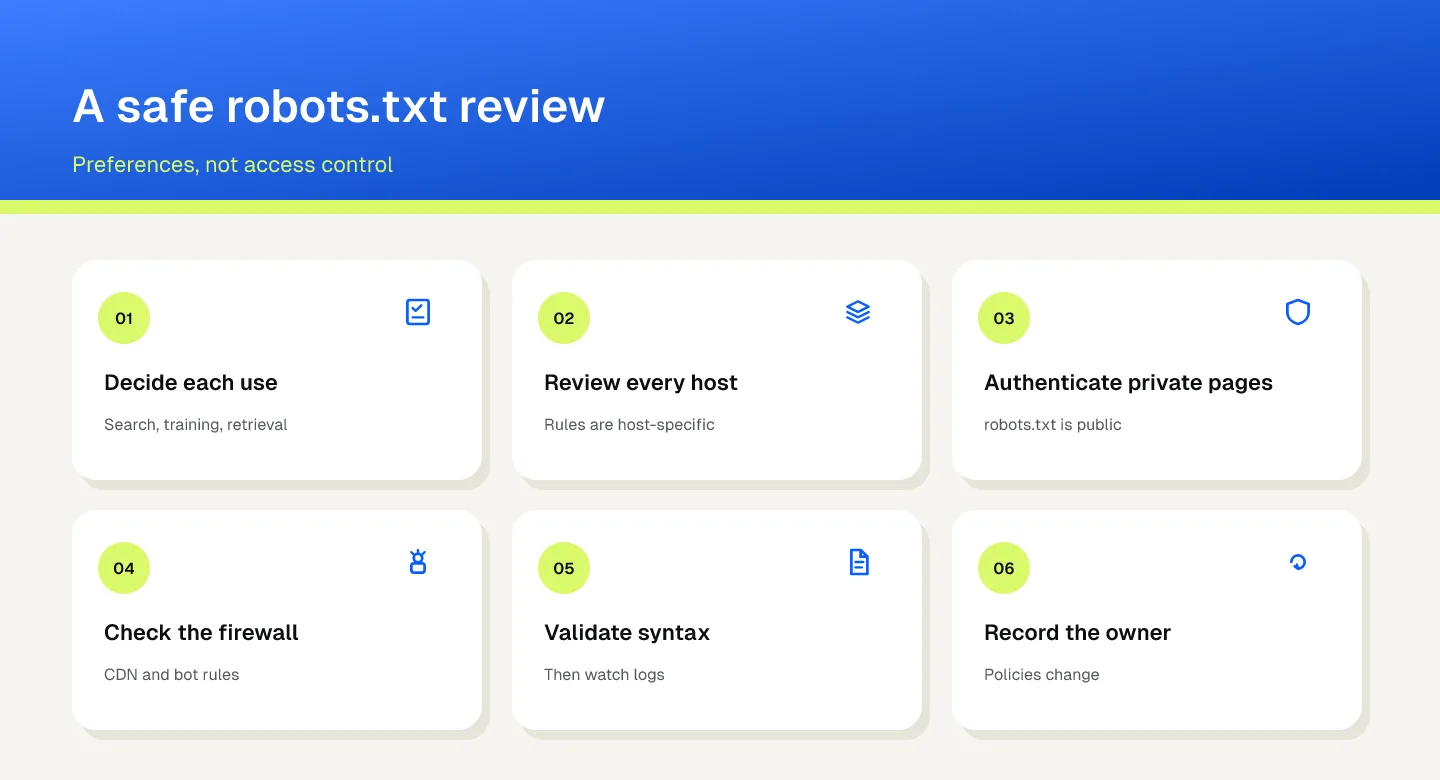
Decide separately whether you want search discovery, training access and user-requested retrieval. Review every subdomain, because robots.txt rules are host-specific.
| Provider | Control | What the provider says it affects |
|---|---|---|
| OpenAI | OAI-SearchBot | Whether pages can be surfaced in ChatGPT search answers. |
| OpenAI | GPTBot | Whether crawled content may be used to train OpenAI foundation models. |
| OpenAI | User-initiated fetches | Fetches for certain user actions. OpenAI says robots.txt may not apply to these requests. |
| Googlebot | Crawling for Google Search, including supporting links in AI Overviews and AI Mode. | |
| Google-Extended | Certain Gemini training and grounding uses. It does not affect inclusion or ranking in Google Search. | |
| Anthropic | Search, training and user retrieval | Claude search indexing, public content that may contribute to future training, and retrieval for a user query, which can be controlled separately. |
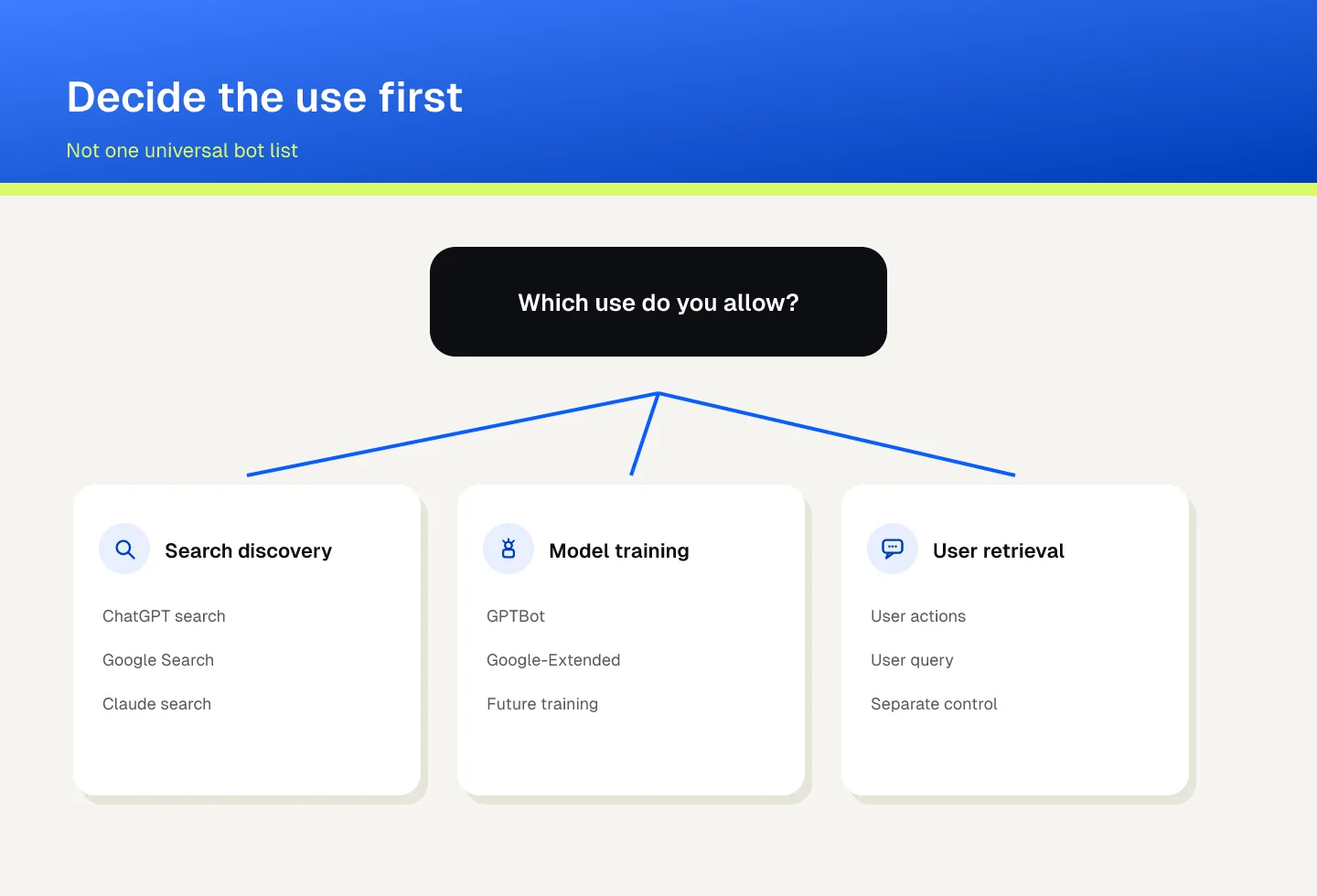
An example that allows ChatGPT search discovery and opts out of the OpenAI training crawl looks like this: User-agent OAI-SearchBot with Allow /, then User-agent GPTBot with Disallow /, plus a Sitemap line for the real host. Treat it as an illustration of separate controls, not a recommended policy for every site.
No. Access only makes retrieval possible. It does not guarantee crawling, indexing, citation, recommendation or any particular wording.
Not automatically. Search discovery, model training and user-triggered retrieval are different uses. The correct policy depends on your content rights, privacy, infrastructure and visibility goals.
OpenAI documents GPTBot and OAI-SearchBot as independent controls. GPTBot relates to training, while OAI-SearchBot relates to ChatGPT search discovery.
Google states that Googlebot controls access for Search, including its AI features. Google-Extended controls certain Gemini training and grounding uses and does not affect Google Search inclusion or ranking.
No. It is a public crawling preference. Confidential content should require authentication or other effective access controls.
The controls above are summarised from the provider documents linked here. Policies change, so check the current page before you publish a rule.
Open ViziGEO and review a documented sample of questions, mentions, recommendations and citations. The audit records what was observed. It does not guarantee a mention, a citation or a recommendation.