Build an AI visibility benchmark your team can defend
A benchmark is a dated, scoped starting point for how a brand and selected competitors appear across an approved panel of AI buyer questions. It is not a permanent ranking.
ViziGEO Team4 min read
Key takeaways
Record the market, language, audience and approved competitor set.
Use versioned buyer questions grouped by intent, not a loose keyword list.
State the system, collection window and repetition rules before the first observation.
Keep answer-level mentions, recommendation context, URLs and cited domains.
A named reviewer approves any material conclusion. A checklist does not authorise publishing or outreach.
Contents
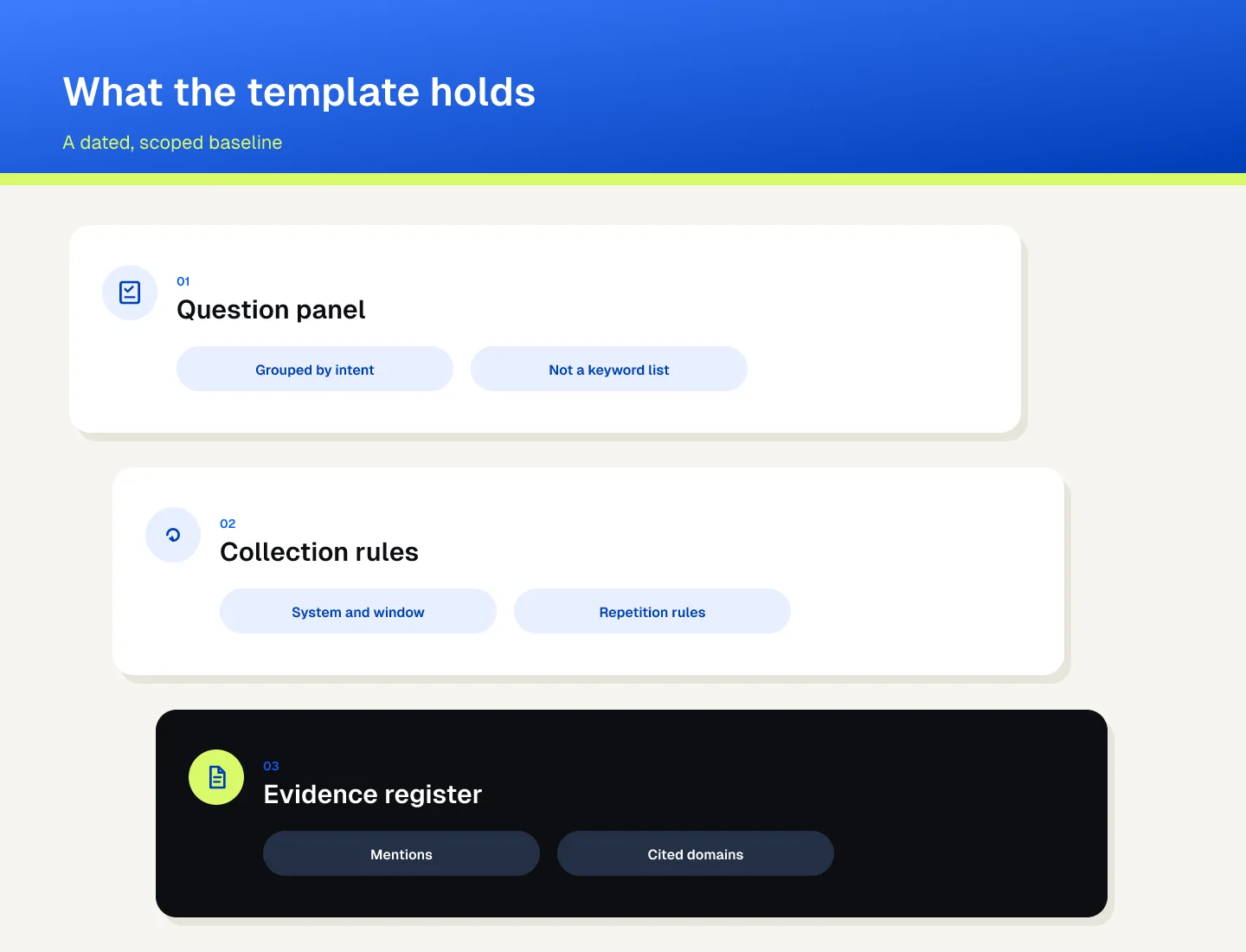
What the template contains
Market, language, audience and approved competitor set.
Versioned buyer questions grouped by intent, not a loose list of keywords.
System or interface, collection window and repetition rules.
Answer-level brand mentions, recommendation context, URLs and cited domains.
A published numerator and denominator for each reported metric.
What the evidence supports, what remains a hypothesis and what needs another sample.
A useful report is an evidence register with a declared scope, not a collection of favourable screenshots.
A minimum before you compare patterns
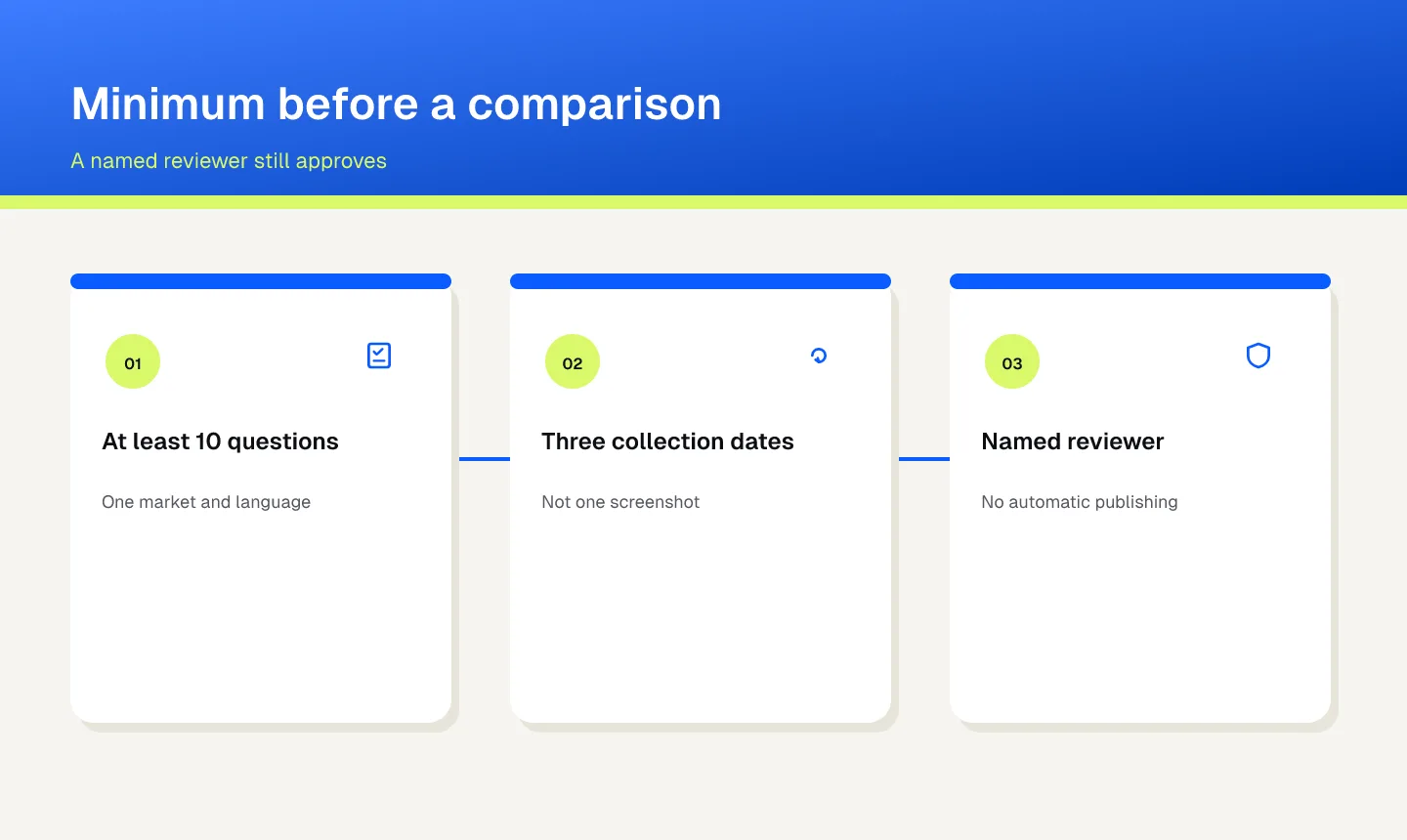
Freeze at least 10 buyer questions, their intent, market and language before the first observation.
Record the observed system or interface, collection date, access method and methodology version.
Observe each question-system pair across at least three distinct collection days before comparing patterns.
Preserve errors, no-answer outcomes and source-less answers in the evidence register rather than removing them.
State what the panel cannot represent, including changes caused by time, context, product updates or method changes.
A named reviewer approves any material conclusion. Passing a checklist never authorises publishing, outreach or product changes.
Select at least 10 buyer questions for one primary market and language, then observe them across three distinct dates.
Operating notes
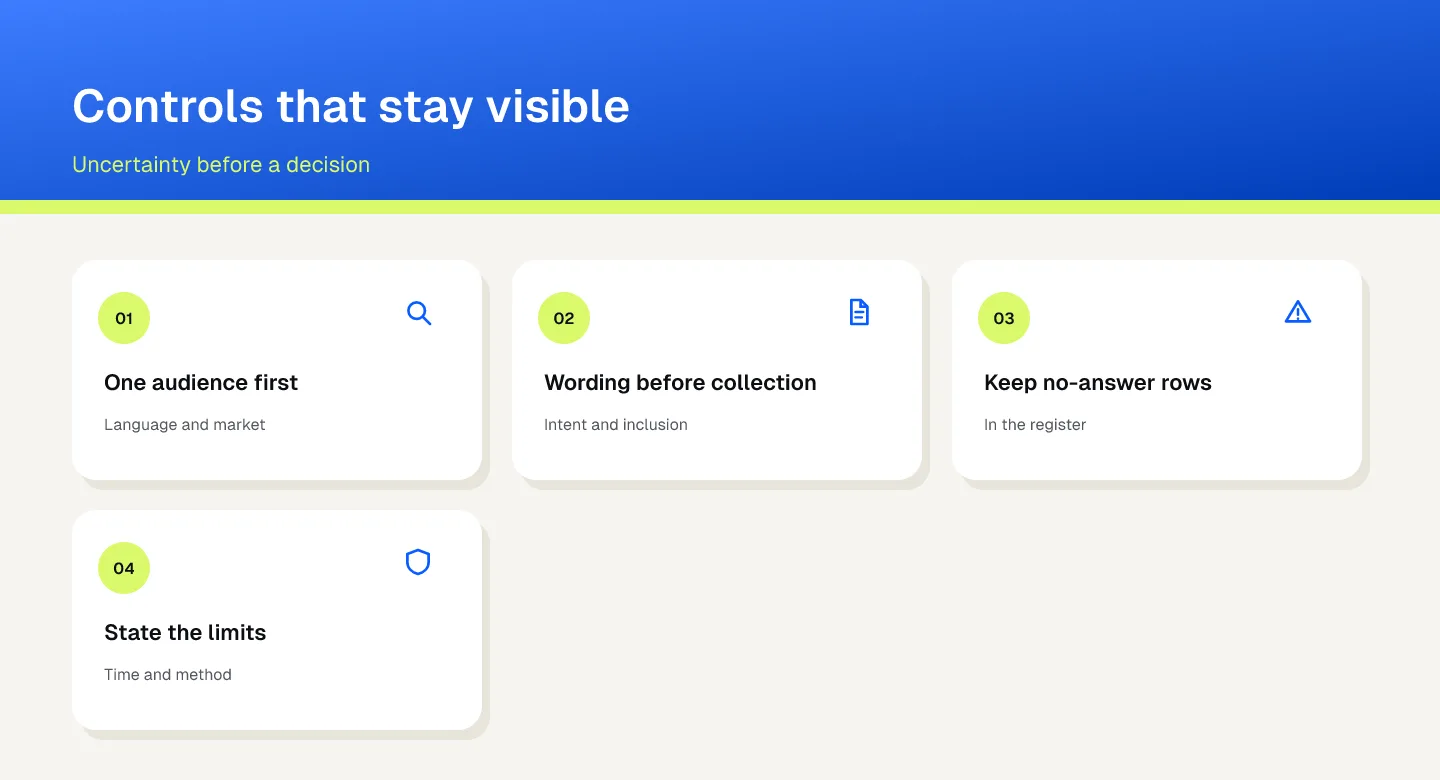
Start with one audience, language and market. A small comparable panel is more useful than unreviewed global volume.
Document the wording, intent and inclusion rules before collecting. This makes future comparison possible.
Collect each approved question-system pair on at least three distinct dates. Retain answer context and record whether evidence was eligible.
Separate observed facts from interpretation. Recommend work, but keep publishing and outreach behind approval.
Define relevant competitors only where comparison is useful to the buyer decision.
Keep failed retrievals and no-answer outcomes in the denominator.
These controls make uncertainty visible before anyone uses a result to choose content, technical or authority work.
Google explains that its AI Search features remain grounded in its core Search ranking and quality systems. OpenAI notes that ChatGPT Search can link to relevant web sources and that outputs may still be inaccurate. These are methodological boundaries, not predictions that a brand will appear in a given answer.
Frequently asked questions
What is an AI visibility benchmark?
It is a dated, scoped starting point for how a brand and selected competitors appear across an approved panel of AI buyer questions. It is not a permanent ranking or a guarantee of future answer inclusion.
Why is a question panel better than a keyword list?
AI systems answer questions in context. A question panel preserves intent, wording, market and language so results can be reviewed and repeated instead of being reduced to a single keyword score.
What should a benchmark report avoid?
It should avoid invented causation, hidden denominators, a single universal score and claims that any tool can guarantee a recommendation or citation in an AI answer.
Who may approve a conclusion?
A named reviewer approves any material conclusion. Passing a checklist never authorises publishing, outreach or product changes.
Sources
The boundaries about Google AI Search and ChatGPT Search come from the official pages below. The template itself is a ViziGEO method.
Open ViziGEO and review a documented sample of questions, mentions, recommendations and citations. The audit records what was observed. It does not guarantee a mention, a citation or a recommendation.